
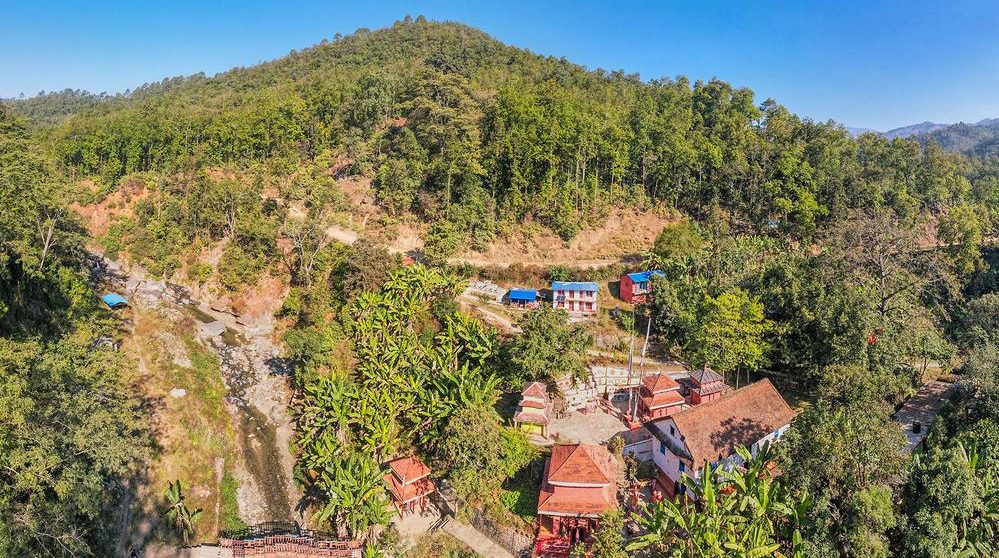
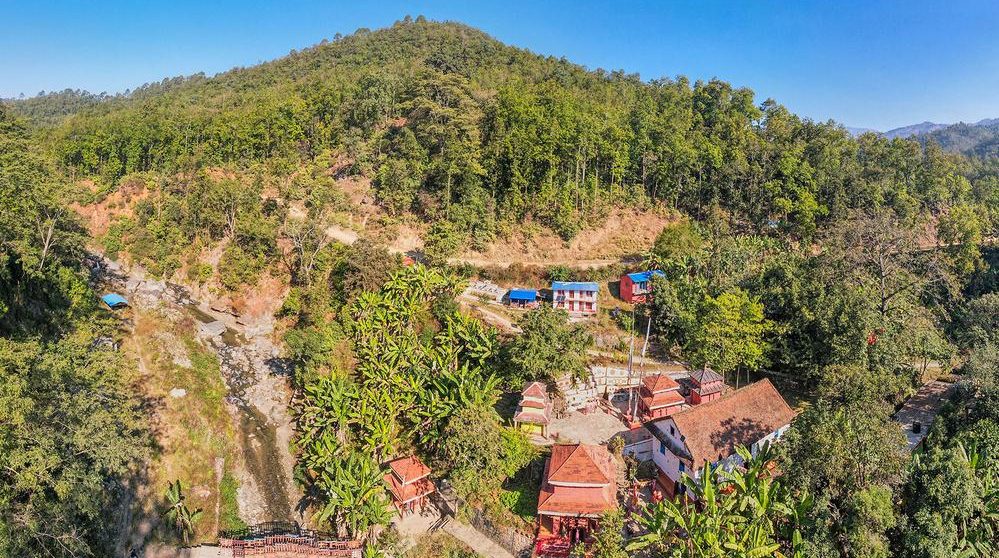
Located in Dailekh district of Karnali Province, Panchakoshi Dham is increasingly being recognized not only as a sacred pilgrimage site but also as a center of mythology, history, Khasa civilization, Shakti tradition, and natural mystery.
The ongoing Skanda Purana recitation program being held from Baisakh 13 to 19 has once again brought the religious and historical significance of the region into public attention.

According to local religious traditions, Panchakoshi Dham is associated with the “Jwala Tirtha” (Sacred Fire Pilgrimage) and “Vaishwanar Tirtha” mentioned in the Himavat Khanda of the Skanda Purana. In Vedic philosophy, the term “Vaishwanar” symbolizes cosmic fire, sacrificial energy, and the life force of the universe.
The Rigveda describes fire as the bridge between humans and the divine. For this reason, many devotees consider the naturally burning flames emerging from the earth in Dailekh as a living form of the ancient Vedic fire.
Particularly in Dhuleshwar, the continuous flame rising from underground remains a subject of both religious devotion and scientific curiosity. While locals worship it as a divine flame, geologists believe it may be linked to natural gas seepage and hydrocarbon deposits beneath the earth.
Local belief also connects Panchakoshi Dham to the Shakti tradition of Sati. According to Hindu mythology, after Sati self-immolated during King Daksha’s yajna, Shiva wandered the universe carrying her body in grief. Lord Vishnu then used the Sudarshan Chakra to divide her body into pieces, which fell across different sacred locations on earth.
The five sacred sites of Panchakoshi are believed to represent five divine parts of Sati’s body.
Shirsthan is believed to be the place where her head fell and is worshipped as a center of consciousness and wisdom. Nabhisthan is associated with her navel and symbolizes life energy and creation.
Similarly, Dhuleshwar represents divine fire energy, Paduuka Sthan symbolizes sacred footsteps and spiritual completion, while Siddheshwar Mahadev is linked with meditation, spiritual power, and liberation.
Local oral traditions also connect Panchakoshi with the era of the Mahabharata. According to popular belief, the five Pandavas visited this region during their exile and performed meditation and penance here. Ancient stone structures, temples, and ruins in the region are often associated by locals with the Pandava period.
Dailekh is also regarded as an important center of the ancient Khasa civilization. Historians believe that nearby Dullu once served as the winter capital of the Khasa kingdom. Ancient inscriptions, temples, hero stones, and religious monuments found in the area reflect the rich historical heritage of Karnali civilization.
Kotila Mandir, associated with the Panchakoshi region, is regarded as a center of Shakti worship and tantric spiritual practice. The word “Kotila” is interpreted locally as representing infinite or countless divine energies.
Local sources also mention an ancient “Kothar Ghar” (traditional storage structure) in the Nabhisthan area, believed to have been used for storing grains, ritual items, and managing pilgrimage activities. Although detailed archival documentation remains limited, the oral history surrounding the structure is still alive among local communities.
Historian and spiritual scholar Yogi Naraharinath extensively studied the religious and historical importance of the Karnali region. Locals still remember the “Kotihom” ritual performed in 2046 B.S. as a major spiritual revival event connected to Panchakoshi Dham.
Elders and traditional shamans of the region also speak of black stones, smoke-emitting rocks, and coal-like substances found in the area. Geological studies have indicated the possibility of petroleum, natural gas, and carbon-rich layers beneath Dailekh’s landscape.
The ongoing Skanda Purana recitation program includes Kalash processions, Rudrabhishek rituals, fire sacrifices, devotional singing, evening aarti ceremonies, and spiritual discourses. Organizers say the event will conclude on Baisakh 19 with a grand final ritual and distribution of prasad.
Local business owners say the religious gathering has positively impacted tourism, hotels, and economic activities in the district.
Mythology, Shakti tradition, Pandava legends, Khasa civilization, eternal flames, and scientific mystery — together, these layers are gradually establishing Panchakoshi Dham as one of Nepal’s most mysterious and spiritually significant sacred landscapes.
Comments
Related Post




great research